


LEARN ➔ CONNECT ➔ ENGAGE
OUR GLOBAL CITIZENSHIP
EDUCATION FRAMEWORK
The CheckWorld framework is designed to travel. To learn about the world's diverse civilizations, to connect with its peoples, and become part of its future. Every CheckWorld Cultural Diplomacy Mission is designed this way, serving as an opportunity for young people to learn, connect, reflect, and participate. Whether a mission takes them to a community close to home or across continents, our expeditions are built to develop the knowledge, empathy, and sense of responsibility needed in the next generation.
UNESCO-ALIGNED
Our travel curriculum aligns with the three core pillars of UNESCO’s Global Citizenship Education (GCED):
[COGNITIVE FOUNDATION] Learn ➔ [SOCIO-EMOTIONAL ENGAGEMENT] Connect ➔ [BEHAVIORAL ACTION] Engage. This framework gives every CheckWorld Cultural Diplomacy Mission a clear purpose, whether it is a 4-day local Quest or a 15-day international Mission. Together, these pillars shape the CheckWorld experience from preparation to participation, ensuring every mission delivers measurable learning outcomes regardless of duration or location.
PHASE 01: LEARN - COGNITIVE FOUNDATION - INQUIRY AND CRITICAL THINKING
When participants; known as Questers, arrive at a destination, they begin with an informed understanding of the host civilization. On Mission Day 1, we build a foundation by exploring the civilization’s history, people, institutions, language, and cultural heritage. Greetings, basic vocabulary, honorifics, cultural etiquette, and local protocols are essential components of this Historical and Cultural Literacy preparation. Questers discover how the host civilization, including its traditional institutions, monarchies, indigenous leadership, and contemporary administrative systems, has organized itself across generations.
Tangible and intangible heritage; including historic monuments, heritage sites, living traditions, food, music, art, architecture, craftsmanship, ceremonies, and festivals, are introduced during

this foundation. This orientation and heritage preparation, ensures that on Mission Day 3, Questers explore historical landmarks, regional arts, and local gastronomy, with context and understanding.
The Driving Question:
“What can we understand about a people when we take the time to learn their story?”
PHASE 02: CONNECT - SOCIO-EMOTIONAL ENGAGEMENT - CONNECTING WITH THE WORLD - MEETING THE PEOPLE BEHIND THE PLACES

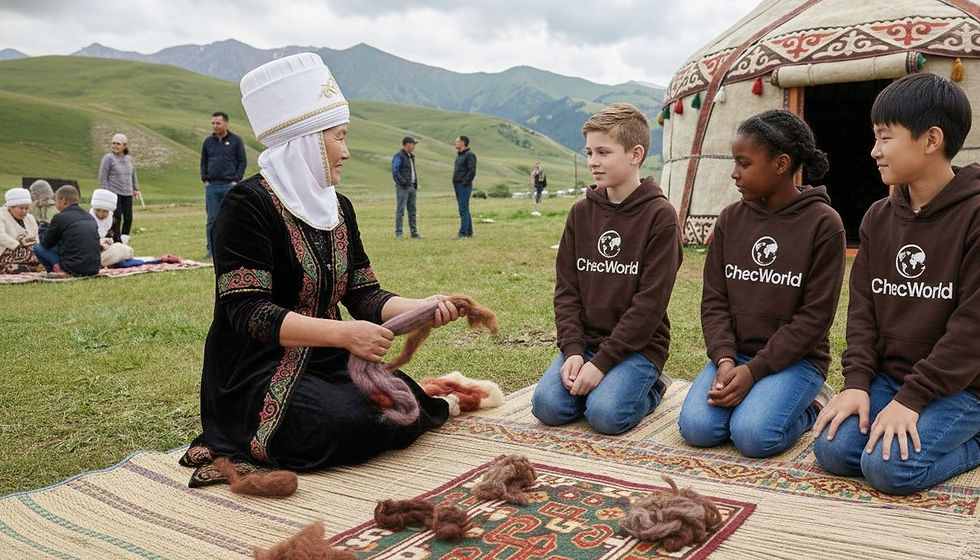
In answering the question: “What can we understand about a people when we take the time to learn their story?” Cultural immersion and diplomacy begin. Questers encounter the host community through meaningful conversations, active observation, and shared experiences. They discover how a simple, respectful greeting can mark the beginning of a genuine bilateral relationship. Audiences with traditional rulers, elders, civic leaders, cultural custodians, and local community members allow Questers to gain firsthand perspectives, cultivating empathy, respect, intercultural fluency, and a sense of shared humanity.
Through this Cross-Cultural Dialogue, Questers are encouraged to ask questions, listen carefully, and examine their own assumptions.
The Driving Question:
“What changes when we stop looking at a culture from the outside and begin listening to the people who live it?”
Reflection Sessions:
These give Questers room to process their questions. Working together in groups, they analyze stereotypes, recognize prejudice, and connect local traditions to universal values of peace.
PHASE 03: ENGAGE - BEHAVIORAL ACTION - RESPONDING RESPONSIBLY TO UNDERSTANDING
These moments help Questers move past assumptions and discover the common humanity that connects us all. They quickly learn that global citizenship is not just about what we know, how we feel about our discoveries, or reflecting on our responsibilities, but about what we choose to do with that understanding.
The Driving Question:
"Now that you know more, what will you do differently?"
This final phase of the itinerary focuses on ethical action and civic responsibility. It helps Questers articulate how they will advocate for cultural harmony and contribute to positive social change. Where opportunities exist, Questers participate in Community-Led Heritage-Support Projects.

UNDERSTANDING THE MISSIONS: EXPEDITION MODELS
The CheckWorld model is intentionally adaptable. Whether applied to a 4-day regional mission or a 15-day international diplomatic mission, the framework supports short local Quests, multi-city national expeditions, and extended international missions without losing its educational foundation.
* 4-Day Local Mission: Day 1 begins with Cognitive preparation, orientation, and protocol training. Days 2 and 3 feature diplomacy day, cultural immersion and reflection circles, concluding on Day 4 with community engagement and a final capstone presentation.
* 15-Day International Mission: Allows the same framework to unfold across a broader cultural landscape. Questers begin with extended language immersion, historical studies, and contemporary societal analysis before progressing through multi-region engagements and service initiatives.
THE GLOBAL AMBASSADOR ASSESSMENT
Every program evaluates clear, age-appropriate competencies. For example, a Quester is expected to:
* Demonstrate appropriate cultural greetings and protocols.
* Explain the historical significance of key heritage sites.
* Identify core features of a destination’s traditional and contemporary social structures.
* Engage respectfully with individuals from diverse cultural backgrounds.
* Reflect critically on personal assumptions and stereotypes.
* Demonstrate responsible, active participation in community initiatives.
* Effectively communicate key learnings through a final capstone project.
At the conclusion of a mission, Questers synthesize their learning through a presentation, reflection project, or approved capstone activity tailored to the mission's scope. They articulate their discoveries, demonstrate their growth, and define their role as active members of a global community.

The Digital Mission Journal
Upon arrival, every Quester receives a tablet pre-loaded with instructional and educational resources, including their Mission Journal. Daily prompts from this Mission Journal encourage them to record observations, encounters, and personal reflections while connecting their lived experiences directly to the three GCED learning domains. This tool allows CheckWorld and its institutional partners to evaluate genuine engagement well beyond simple participation.
CREDENTIALING
To earn an official CheckWorld recognition and certification as an Ambassador for Culture and Global Peace, a Quester’s growth is evaluated across five core criteria: Participation | Cultural Engagement | Reflection | Community Engagement | Project.
Fulfilling these requirements earns them recognition as a CheckWorlder (an Ambassador for Culture and Global Peace).
When Questers return home, this transformative experience serves as a lifelong foundation for civic responsibility, positive community leadership, and global bridge-building.